Hytale ‘s artificial intelligence system is based on a modular , fast , and highly dynamic architecture , designed to allow the creatures of Orbis to adapt their behavior in real time.
This AI aims for one central objective: to produce credible and lifelike NPCs , capable of reacting like a human player would.
Each NPC is capable of:
- understanding one’s environment,
- interpreting his social relationships,
- adjust his decisions in combat,
- interact with players in a believable way,
- produce unpredictable emergent behaviors.
This system makes Orbis feel alive , responsive , and deeply immersive , with behaviors that seem genuinely natural.
| System | Function | Result |
|---|---|---|
| ECS (Flecs) | Parallel modular architecture | fast, flexible AI |
| Utility System | Dynamic action choice | Realistic behavior |
| Combat Action Evaluator | Tactical Combat AI | Credible confrontations |
| Behavioral scripts | State transitions | Variety and customization |
| Multi-sensory perception | Behavioral triggers | Increased responsiveness |
| Interspecies relations | Living Ecology | Emerging behaviors |
| Baits & stimuli | Indirect manipulation | Richer gameplay |
| Ranking by thirds | Gradual difficulty | Consistent progression |
Technical Foundations
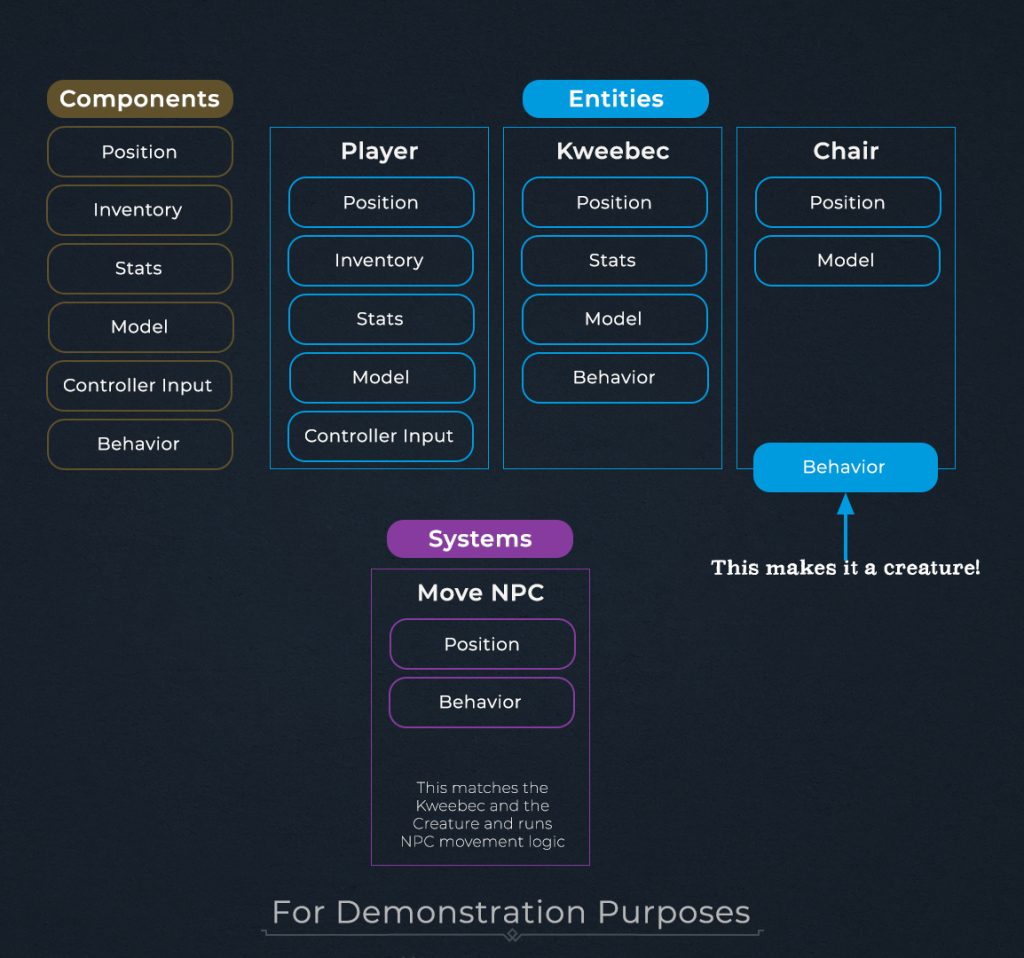
Entity Component System (ECS)
Hytale ‘s AI uses a modern ECS , notably via the Flecs library , offering:
- A total decoupling of behaviors : each function (pathfinding, perception, decision, animation…) is a modular component.
- A natural parallelization , essential for managing dozens of creatures simultaneously.
- Superior responsiveness : behavioral calculations no longer depend on a centralized Java loop.
- An advanced configuration : each NPC can combine a multitude of components (fear, aggression, hunger, detected threat, emotional state…).
Modular decision-making
AI continuously evaluates:
- his internal state (health, fatigue, morale, posture),
- its environment (obstacles, light, terrain, weather),
- its relationships (allies, prey, predators, factions),
- its immediate stimuli (noise, movement, smell, bait).
This set forms the decision-making basis of the two main systems:
the Utility System and the Combat Action Evaluator .
Utility System: Choose the best action at any time
The Utility System is a mathematical system that assigns a value to each possible action. The best action is automatically selected based on:
- the present danger,
- the opportunity (loot, food, vulnerable target),
- the role of the creature (predator, prey, protector),
- its interspecies relationships,
- their emotional state (calm, fear, aggression, curiosity).
Examples of uses
| Situation | Selection via Utility System |
|---|---|
| A Fen Stalker spots a frog | The score for “protect the frog” exceeds that of “ignore”. |
| An injured Trork spots several players | The “flee” score can override “attack”. |
| A mouse detects cheese | The “approach & eat” score becomes the priority |
The system allows for unscripted but consistent behaviors , varying according to individuals and contexts.
Combat Action Evaluator: Tactical Decisions in PvE
The Combat Action Evaluator is the system dedicated to advanced combat decisions.
Thanks to the ECS, it can now:
- analyze several inputs in parallel (target distance, obstacles, angle of attack, health, endurance…),
- recalculating decisions several times per second,
- using feigned behavior, hesitations and margins of error (“fuzziness”),
- produce less predictable attacks.
What NPCs can do in combat
- Change strategy (distance, scrum, retreat).
- Choose a target intelligently (isolated player, main threat).
- Execute or delay an attack depending on the opportune moment.
- Change weapons if the arsenal allows it (e.g. Trork berserker).
- Flee if the situation becomes unfavorable .
The objective: a fight that seems improvised , human, spontaneous.
Perception & Stimuli: How NPCs “read” the world
Perception in Hytale combines several specialized systems:
- Vision : detection of silhouettes, player outlines, projectiles.
- Hearing : sounds of footsteps, impacts, sounds of breaking blocks.
- Odor / Chemical stimuli : mainly for animals (food, danger).
- Ground pressure : vibrations or nearby movements (some sensitive creatures).
- Light & temperature : some species flee from or seek warmth.
These stimuli immediately trigger state transitions via ECS components.
Interspecies relations
Orbis species are not isolated: they follow ecological behavioral patterns :
Types of interactions
- Predator/prey
- Protective symbiosis
- Territorial rivalry
- Temporary alliances (e.g., a friendly NPC helping to repel a common enemy)
Complex example: Fen Stalkers & frogs
The Fen Stalkers:
- They imitate frogs (jumping, posture, curiosity)
- They actively protect them
- They attack any predator that approaches a frog
- Make hunting risky for the player
This is an example of an interspecies relationship coded via the Utility System + ECS , without a static script.
Behavioral scripts & animation states
NPCs change state according to modular scripts connected to the ECS.
main behavioral states
| State | Description | Example |
|---|---|---|
| Alerted | Stimulus detection → analysis | Trork spotting a player |
| Nap | Post-fight sleep, humorous knockout | Trork knocked out |
| Sparring | Friendly simulated fight | Trorks training their warriors |
| Imitation | Reproduction of observed behavior | Fen Stalker imitating frogs |
The animations are not decorative: they reflect the internal state
and can influence decision-making (fatigue, recovery, pride after a workout, etc.).
Case studies: creatures & specific behaviors
Fen Stalkers
- advanced behavioral imitations
- active protection of frogs
- conditioned aggression only in the event of a threat
- use of a comprehensive social/ecological model
Trorks
| Behavior | Description |
|---|---|
| Combat Sparring | Training without intent to kill |
| Nap post-KO | Humorous animation after a fight |
| Rapid detection | Immediate switch to alerted if a player is present |
| Increased responsiveness | Coordination between Trorks of the same camp |
Mice & Bait
- default avoidance behavior
- strongly attracted to cheese
- Several mice can eat simultaneously
- A mouse that is eating becomes less fearful for a few seconds.
- Grouping around chests/dungeons: natural environmental clues
Navigation, terrain & contextual behaviors
AI takes into account:
- terrain (jumps, detours, slope)
- Destructible obstacles (Goblins using bombs to clear the way)
- water, mud, fire, toxic areas
- weather and day/night cycles (many creatures change their behavior at night)
Pathfinding is asynchronous and parallel , therefore much more reactive.
Some creatures even adapt their strategy according to the biome or temperature .
Tier system: classifying enemies by difficulty
| Level | Example | Features |
|---|---|---|
| Low tier | Skeleton | Slow, simple attacks |
| Middle third | weak undead mage | Projectiles, distance |
| High Tier | Elite Undead Mage | Powerful, complex patterns |
This system enriches the progression and diversity of the bestiary.