The future of Hytale is becoming clearer. Recently, Slikey, the game’s Technical Director, sat down for an extensive interview with creator Kaupenjoe. This was a rare opportunity to dive deep into the game’s architectural details and understand how Hypixel Studios intends to revolutionize the sandbox genre. Link of the video here !
Here is the exhaustive report on the technical revelations and the vision shared during this discussion.
1. The Philosophy: “Hytale within Hytale”
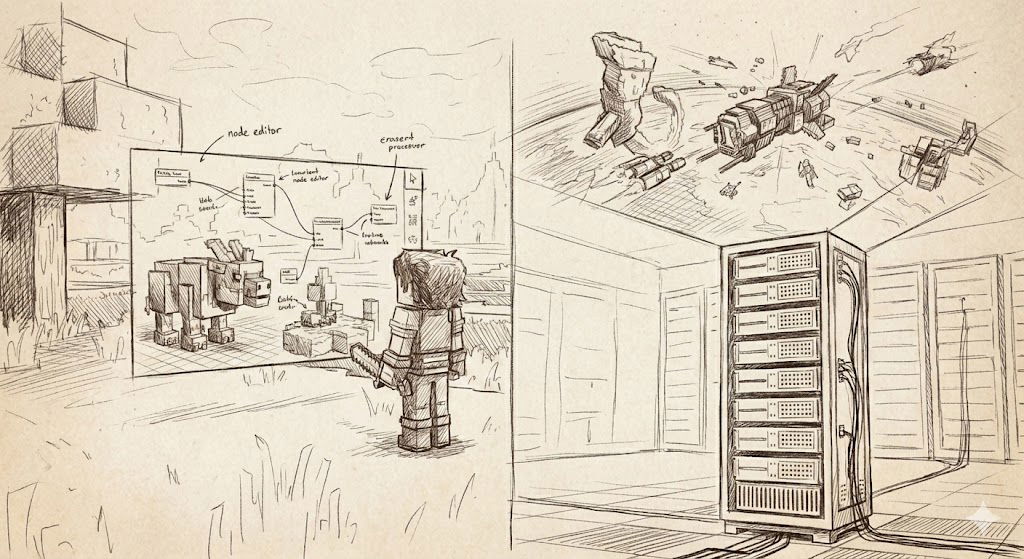
The team’s primary goal is to move past the limitations they faced on Minecraft (Hypixel Network). Slikey explained that Hytale’s engine doesn’t just support a sandbox game; it is a sandbox creation process in itself.
The core idea is to “build Hytale within Hytale.” Nothing is rigidly hard-coded: the team uses their own modding tools to build the base game. This ensures the developers are their own “first customers”—if a developer needs a feature for the game, it automatically becomes a tool available to modders.
2. The Three Technical Pillars of the Server
The server architecture is built upon three interconnected systems:
- Entity Component System (ECS): This is the memory and runtime model. Unlike traditional object-oriented programming, ECS avoids bottlenecks and gives modders total freedom to manipulate game data efficiently.
- Asset System (JSON): The data configuration layer. It handles loading, saving, validation, and—most importantly—hot reloading. You can modify a data file and see the result in-game instantly without restarting the server.
- Plugin System: This system loads extensions (event handlers, component types, etc.). It is designed to be modular and optional. Slikey stated that a modder could technically “remove Hytale from Hytale” to create their own universe from scratch.
3. The 4 Stages of Feature Maturity
Slikey was very transparent about the state of various tools for Early Access:
- Mature (No-code Accessible): These features are already integrated into the in-game node-graph editor. This includes blocks, World Gen V2, items, visual effects (VFX), animations, weather, and loot tables.
- Moddable (JSON & Plugins): Feature-rich systems that currently lack a full graphical interface. Modders may need to edit JSON files or write plugins for NPCs, interactions, inventories, or the camera.
- Prototype: Systems that are still hard-coded as the team tests different approaches to find the right abstraction. This applies to physics, inputs, and shaders.
- Deprecated: Systems being phased out, such as the old UI (replaced by Noises GUI in XML) and the old Event Bus (replaced by native ECS events).
4. Performance and Rendering: Enter Jelly Squid
One of the biggest revelations concerns the rendering engine. To ensure peak performance, the studio recruited Jelly Squid (famous for the Sodium and Lithium performance mods on Minecraft).
- No “Hytale Optifine”: The rendering engine itself will not be moddable. The team wants it to be so performant out of the box that third-party optimization mods become unnecessary.
- Shader Graph: While the core renderer is closed, players will have access to a node-based shader graph asset (similar to Unity) to create custom visual effects safely.
5. Reimagined Network Infrastructure
Slikey reflected on the struggles with BungeeCord on Minecraft (costly and fragile proxies).
- Native Transfers: Hytale natively handles moving players between servers and instances.
- Server-Authoritative: The server has final control. This prevents cheating via client-side mods, ensuring a fair experience for everyone.
- WebAssembly (Wasm): For the UI and client-side scripts, Hytale uses WebAssembly. This allows code to run at near-native speeds while remaining within a secure “sandbox” on the player’s computer.
6. Mod Distribution and CurseForge
Hytale does not want to be a “Walled Garden.” Slikey confirmed:
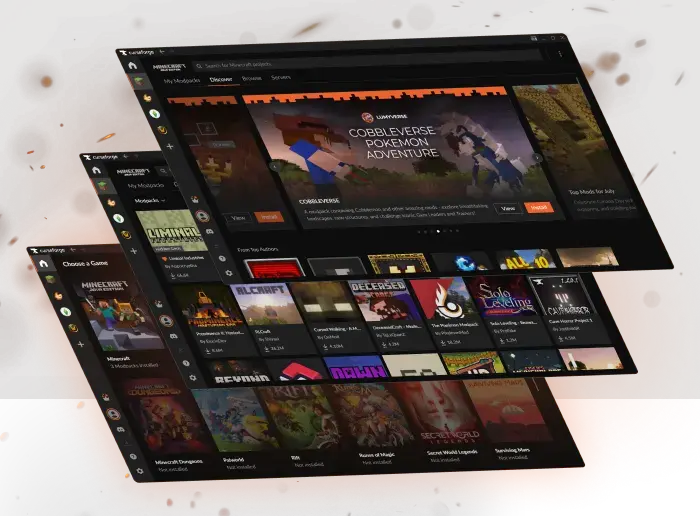
- Discussions are ongoing with platforms like CurseForge to support the existing modding ecosystem.
- Automatic Synchronization: When a player joins a server, the client automatically downloads all necessary assets and scripts. No more hunting for modpacks on third-party sites.
7. Version Management and Server Freedom
- Ending the “Version Jungle”: Hytale aims for one update per week, with a pre-release available 7 days early for creators. The game auto-updates but allows players to roll back to the immediately preceding version (n-1).
- Monetization and Liberty: Server operators will have significant freedom (Anarchy, cosmetics, Pay-to-Win). However, Hytale will include a content filter system based on ratings. Players can filter out servers based on maturity or economic models.
8. Slikey’s Vision: Passion and Ambition
The interview concluded on a human note. Slikey, who has dedicated his entire 20s to Hytale, emphasized that the project is driven by passion, not as a “money grab.” His dream? To see players create experiences as complex as a space MMO like EVE Online within the Hytale engine.